All posts by kvkadmin

Success story on Cluster FLD on Rabi Pulses 2016-17

Success story on technology/variety under Cluster FLD on Rabi Pulses 2016-17

Success story on Cluster FLD on Rabi Pulses 2016-17

iName of KVKNagapattinam  
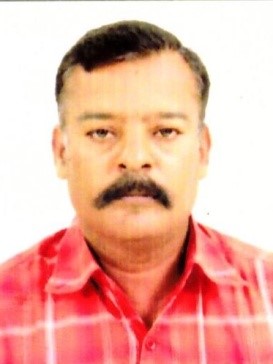
iiName and address of farmer along with photograph  Mr. C. Karthikeyan S/O. Chinnapannai Kongarayanallur, Thirumarugal Block Nagapattinam District          
iiiCrop and variety  Black Gram VBN 6
ivFarming situationRice fallow condition
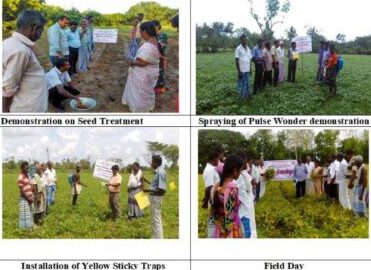
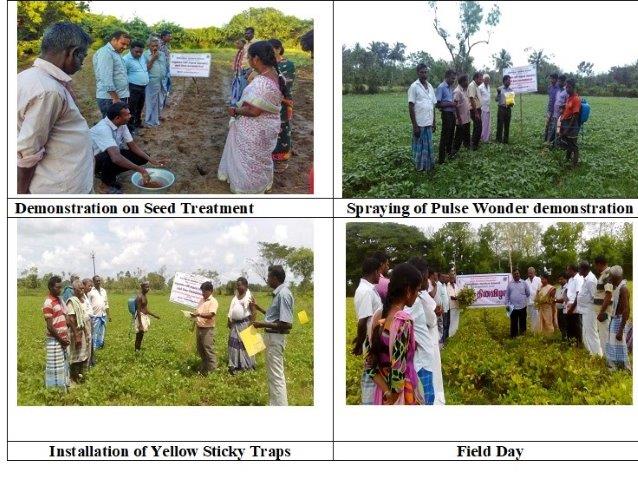
vDetails of technologies demonstratedSeed treatment with Imidacloprid  48 % FS @ 5 ml/kg of seed, Seed treatment with Trichoderma viride @ 4 gm/Kg of seed andSeed treatment withRhizobium 20 gm/kg of seed Foliar spraying of TNAU Pulse wonder@ 5 kg/ha ,Installation of Yellow sticky trap for controlling white flies@ 5 Nos. /Acre.  
viFarmers practice (check variety)ADT 3
  viiPerformance of technology vis-à-vis local check (increase in production & productivity with net returns)Yield (q/ha)Net returns (Rs./ha)Yield gap (q/ha) over check
DemoCheck% increaseDemoCheck% increase4.0
7.53.553.3418801061174.66
ViiFarmers feedback  for crop & technology  VBN 6 variety is non shattering and synchronized maturityHighly resistant to Yellow Mosaic Virus VBN 6 variety give more yield than check varietyMain advantage of this variety is short duration (60-65days), Suitable for rice fallow condition also.Farmers interested to go for next year.

2. Yield (q/ha)

iPotential yield of variety/ technology8.9
iiDemonstration yield7.5
iiiDistrict average (previous year)5.49
ivState average( Previous year)3.81
vNational average Yield5.0

Success Story on Large Scale Technology Adoption on Integrated Farming System:

Success Story on Large Scale Technology Adoption on Integrated Farming System:

1Name and complete contact address,  Photo & Phone number  
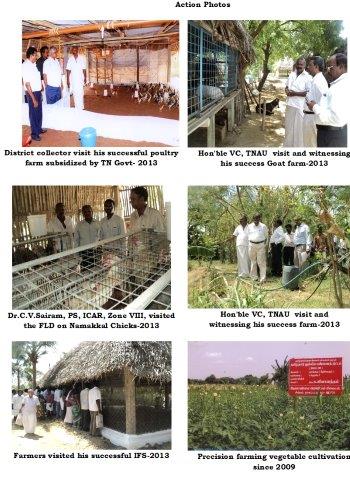
Th.G.Jeevanantham, S/O. Ganapathy, Agarakadambanur-Post, Nangudi, Kilvelur-Tk, Nagapattinam Dt. Phone: 9443375262
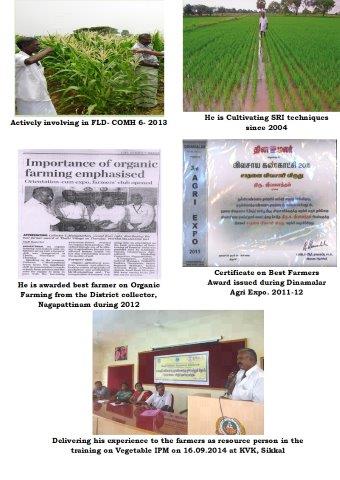
2Date of Birth  24.07.1963
3Father’s name   Mr.M.Ganapathy
4Gender  Male
5Educational qualification12th STD.
6Farm size  Wetland- 48 ha, Garden land- 2.0 ha and Fish pond-1.6 ha
7Crops cultivated /enterprise practiced along with yield and income details  Seed Production of Rice- Rice fallow pulses, and IFS components: Banana – 600 Nos. Amla – 45 Nos. Annual Moringa – 1 Acre. Mango – 50 Nos. Citrus – 15Nos. poultry bapkok – 100Nos. Poultry(Four way cross) – 300Nos. Fish farm 4 acres, Vegetable like Brinjal, Tomato, Chillies,  Snake gourd  and fodder grass CO4 cultivation seed production Rice F1 –CR1009-150 tonnes,                  BPT 5204-60 tonnes,                  ADT 38-40 tonnes,                  ADT 39-40 tonnes, Black gram  (certified seeds) ADT3- 6 tonnes and Green gram ADT3- 3 tonnes. Income details: From seed production Rice- Rs.5,80,000/- Pulses-4,50,000/-  Through IFS component, he is getting the net profit Rs. 2,79,000/ acre/year as compared to Rs. 26,000/acre/year under conventional crop cultivation alone. He used to get the net profit of 65,000 / ha only from the commercialized cropping system of rice – rice – blackgram.
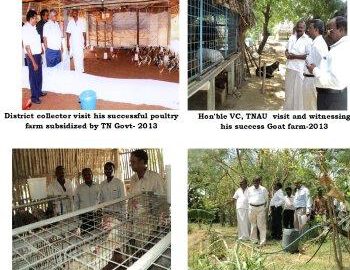
8Technological Intervention by KVK  He is a progressive farmer having knowledge on not only IFS but also other crop cultivation rice, pulses, vegetables etc., He also the first person in Nagapattinam to adopt SRI with the advice of the scientist KVK Sikkal and TRRI, Aduthurai and practicing since 2004. But after the intervention through KVK, Sikkal and his own involvement and interest he emerged as a model farmer of adopting IFS suited to the rice based cropping system.  He is actively involved in conducting of On and Off campus training, OFTs, FLDs. ARTs and MLTs of different crops.He was taken to KVK, Namakkal and skill were developed on Goat farming and IFS. Hybrid goat was distributed to him at Technology week at KVK, Sikkal during 2010.He is one of the pioneer Seed village farmer and seed producer of Rice and rice fallow pulses.
9Significant / unique achievements made by the farmer utilizing the TNAU technologies and services of KVK
aProduction  Rice F1 seed CR1009-150 tonnes, BPT 5204-60 tonnes, ADT 38-40 tonnes, ADT 39-40 tonnes, Black gram  (certified seeds) ADT3- 6 tonnes and Green gram ADT3- 3 tonnes.
bMarketing of Agrl. commodity  He is marketting of following Agricultural commodity  Rice F1 seed CR1009-150 tonnes, BPT 5204-60 tonnes, ADT 38-40 tonnes, ADT 39-40 tonnes, Black gram (certified seeds) ADT3- 6 tonnes and Green gram ADT3- 3 tonnes and sold to the Agrl. Department and private seed company.
cExtension  During On campus training on IFS, the farmers were taken to his farm at Nangudi village through exposure visit regularly. At present more than 50 farmers are following  his IFS technologies especially on Stall fed method of goat farming.
10Name of the farmers / farmer groups who were influenced by the achiever farmer to achieve the same way as he or she has achieved.  More than 50 farmers were adopting this IFS technologies in the district and few farmers are adopted the technologies are following 1. Th.S.Balakrishnan,      East Street,
     Sikkal-611 108      Nagapattinam District,     Mobile No. 9442101445, 2. Th.J.Govind,     Manalur,     Kilvelur- Taluk
    Nagapattinam District.     Mobile No:9095999100. 3. Th.P.Thangarasu     Aanaimangalam-611 104     Kilvelur -Taluk     Nagapattinam District. 4. Th.S.Gnanasekaran,      Vandalur,      Mohanoor- Post      Kilvelur- Taluk     Nagapattinam District.     Mobile No: 8012963013. 5. Th.Muthukumarasamy.     Thiruvaimoor,     Keezhaiyur     Thirukkuvalai -Taluk     Nagapattinam District,     Mobile No: 9786872928.  and Members of “Kakkum karangal farmers Club” sponsored by NABARD, Nagapattinam Dt.
11Name of the farmers to whom the achiever farmer has shared information about TNAU technologies /trained other farmers with details.Past three years more than 1000 farmers were visited his success farm. He has shared information about TNAU technologies among the farming community.
12Recognitions received by the farmer for the past three years.    Awarded best farmer on Organic farming from the District collector, Nagapattinam during 2012.Awarded best Farmer from Dinamalar Agri. Expo during 2011-12.He is awarded 3rd prize for best farmers Club- Kakkum karangal during 2010 and he is the leader of this club.
13Specific recommendation of the Programme Coordinator of KVK with justification.Submitted and recommended for consideration please    

Success story on Rice variety TKM 13

Success of paddy variety TKM 13 cultivation in Nagapattinam District

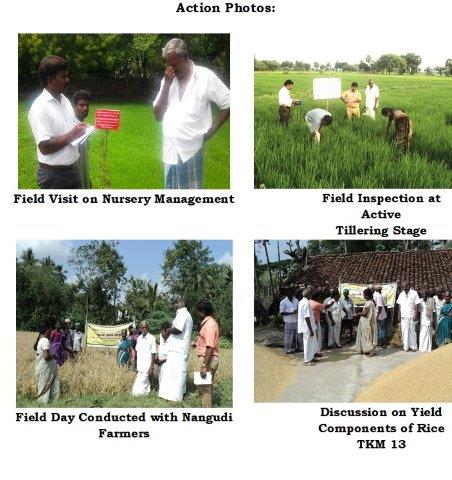
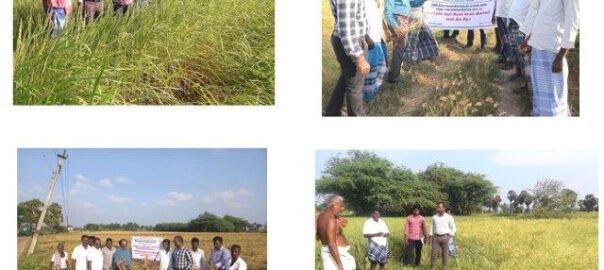
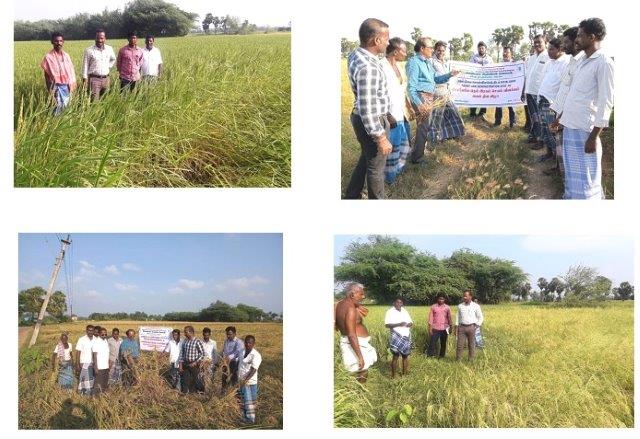
Newly released rice variety TKM 13 (TNAU, 2014) was demonstrated through Front Line Demonstration in farmers’ field of Kilvelur block (Iluppur, Anaimangalam, Nangudi and Pattamangalam), Nagapattinam block (North Poigainallur, Vadavur and Sikkal) Thirumarugal block (Marungoor), Sembanarkoil block (Anaimattam) during Thaladi season 2015 in Nagapattinam District.

Among the ten demonstrations, Mr. G. Jeevanantham S/o Th.Ganapathi, Nangudi, Kilvelur block of Nagapattinam district who is 53 years old progressive farmer and his qualification is HSC. He has successfully cultivated TKM 13 paddy variety and produces an average yield of 1800 Kg per acre even in the unfavorable flood condition. He told that with the technical support of KVK, Sikkal, Nagapattinam following Integrated crop Management practices were adopted.

  • Seed treatment with Pseudomonas (10 g/kg of seed)
  • Seed treatment with Azophos @ 200g/ 16 kg of seed
  • Transplanting of 25 days old seedlings with the spacing of 20×10 cm,
  • Provided rogue spacing for every 8 rows
  • Planted parallel to sunlight
  • Root tipping of seedlings with Pseudomonas fluorescens @ 1kg in 20 liter of water was done before transplanting.
  • Soil application of P. fluorescens @ 1 Kg/acre on 15 days after transplanting and application of foliar spray of P. fluorescens @ 1 kg/ac in 200 lit of water during before and after flowering.
  • Application of 30 kg of urea, 40 kg of DAP and 10 kg of muriate of potash per acre as basal. The top dressing of was given during active tillering, panicle initiation and flowering stage with 30 kg of urea and 10 kg of muriate of potash per acre at each time.
  • Application of Gypsum @ 200 kg/ acre and zinc sulphate @ 10 kg /acre during the time of last ploughing.
  • Application of Azadirachtin (10,000 ppm) @ 500 ml/ac was done to manage the sucking pest.
  • Soil application of Beuveria bassiana and Lecanicillium lecanii @ 2 kg/ acre at tillering stage to manage the larval pests and sucking pests respectively
  • He earned Rs.14,000/- as a net return from one acre of land.

Comparison of cost and economics between BPT 5204 and TKM 13

Sl.No.ParticularsBPT 5204TKM 13
1.Yield (kg/ac)14701800
2.Cost of cultivation (Rs./ac)1600016000
3.Gross income (Rs./ac.)2450030000
4.Net return (Rs./ ac.)850014000
5.BC Ratio1.61.88

He said that yield of  TKM 13 of rice variety was recorded  1800 Kg per acre with improved agricultural management practices over farmers practice (1470 kg/ac)the number of productive tillers 354/m2.    Because, this variety is moderately resistant to leaf folder, stem borer, green leaf hopper, blast, rice tungro disease, brown spot, sheath rot diseases and lodging resistance compared to BPT 5204 it will be best alternate to BPT 5204 variety in Nagapattinam district. Moreover, this variety is highly responsive to fertilizers and manures, it has high milling yield and head rice yield.  

Success story on Varietal spread Black Gram VBN 6

Success story on Black Gram VBN 6 variety makes a farmer to uplift the farm income 2016-17

Background

Mr.G.Jeevanantam S/O. Ganapathy, was successfully cultivating Black gram VBN 6 during summer and Kharif season. In his field, Cluster Front line demonstration was conducted on Rabi pulses using Black Gram VBN 6 variety during 2015-16 and training on Integrated Crop Management technologies for pulses crop was conducted.

Intervention process

He approached KVK, Sikkal for getting guidance for the intensive cultivation of all crop especially like rice, pulses and vegetable. Moreover, he got some useful information related to cultivation of irrigated pulses.  He was actively involved in taking up this cluster FLD demonstration on Rabi pulses.

Intervention Technology

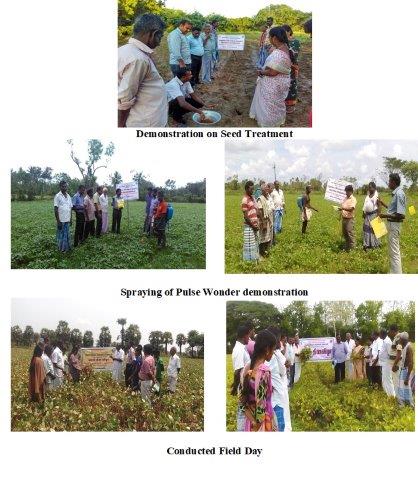
He gathered knowledge on seed treatment with bio fertilizers, Nutrient    management and application of TNAU Pulse Wonder during peak flowering stage through the trainings.

The following technologies were adopted in the black gram cultivation.

  • Seed treatment with Imidacloprid 5ml/kg of seed.
  • Seed treatment with Rizhobium 250 gm and Trichoderma viredi 4 gm/kg of seeds.
  • Basal application of fertilizers Urea 15 kg, DAP 25 kg and MOP 15 kg/acre before sowing.
  • Foliar spraying of TNAU pulse wonder @5 kg/ha.
  • Installation of pheromone traps @ 12 nos/ha.

Economic gains:

Sl.No.ParticularsADT 3VBN 6
1No. of Pod/plant3665
2Yield (q/ha)7.020.0
3Gross Return (Rs./ha)70,0002,00,000
4Net Return (Rs./ha)50,0001,37,500

Impact on Horizontal spread

Through the sale VBN 6 as seeds more than 100 farmers were benefitted and provided seed to Department of Agriculture for double the income. Exposure visit was arranged among the farmers to visit his field to popularizing this success for large scale adoption.

Impact on Employment Generation

          He generated regular employment for 10 persons.

Large scale adoption:

Black gram variety VBN 6 was popularized through cluster FLD on Rabi pulses among the farmers of Nagapattinam district during 2015-16 and 2016-17. Now the variety black gram VBN 6 is cultivated in large scale area more than 15000 hectares over 43030 hectares of Black gram.  

GIFT Tilapia production in Farm Ponds

GIFT Tilapia production in Farm Ponds

Introduction

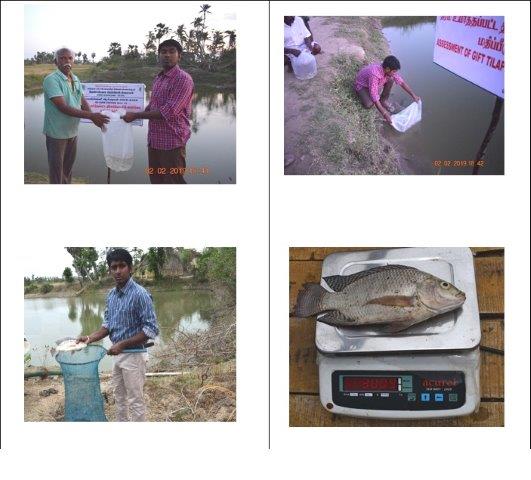
Venukalidoss is a fish farmer from Marachery village doing fish culture for the past 10 years. He has 1 acre pondwhere he used to culture carps using the river water. He has little knowledge about fish culture and was doing thisas an allied farming activity in addition to paddy culture. Usually the ponds were stocked with fingerlings of IMC purchased from local fish farms without carrying out any prestocking management measures. The fishes were fed with farm made feeds including boiled rice based on the feed intake of fishes. After a culture period of 8–9 months due to the shortage of water supply fishes are harvested and marketed inThanjavur and Mannarkudi areas.

Problem identified

  • Fertilization of pond is not done properly.
  • Lack of awareness about GIFT tilapia culture in the village
  • Lack of awareness about importance of feeding in fish culture
  • Short duration of water availability in the village
  • Long duration of culture for carps
  • Prolific breeding behaviour of wild Tilapia fishes
  • Water quality parameters are not taken into consideration/not tested before stocking fishes for culture.
  • High stocking density of fishes

KVKs intervention

  • Fish farmer was identified first for implementing GIFT tilapia culture technologyin the village
  • Fish pond was identified for stocking GIFT tilapia fishes
  • Water quality parameters tested for suitability of water for culture
  • Bunds were not constructed properly and suggestions were given to make it clear
  • Advised to clear unwanted bushes and plants in the pond area
  • Advised to add fertilizer (cow dung) for natural phytoplankton production
  • GIFT tilapia of 1500 Nos were stocked in the area of 500m2 pond
  • Fishes were fed with commercial pellet feeds at 5% body weight for 3 months
  • After 3 months  it has reached an average body weight of 314g
  • The fishes reached the market size within three months

Output and outcome

  • An yield of around 376 kg were harvested from the culture
  • Fishes were marketed as live at the rate of Rs.100/kg
  • Gross income of Rs.37,680/- was achieved from the culture
  • High resistance to diseases compared to carps
  • Fish farmer is motivated to take up GIFT tilapia as next crop as this technology earns money in a short period of time with limited water availability
  • He also commented on the palatability of GIFT tilapia as this has good consumer preference
  • He also advised other fish farmers to take this technology as this has a suitability for our district

Demonstration of Traditional rice variety with Eco friendly management

Demonstration of Traditional rice variety with Eco friendly management

Introduction:

Since the beginning of Green Revolution in the 1960s, increasing the yield of paddy was the main objective. Hence, we started adopting high yielding rice varieties by forgetting our traditional rice varieties. Nowadays, throughout Tamil Nadu more than 100 high yielding rice varieties are being cultivated. However, the incidence of pest and disease increased which resulted in higher application of pesticides eventually affecting the environment. This has hiked the production cost of high yielding varieties compared to the traditional ones. The traditional variety seeds and grains costs are almost two to three times higher than our normal ones. Currently, people are looking for organic products which created a demand for the traditional varieties.  The traditional varieties are rarely affected by pest and diseases and hence there is less need of pesticide application. The management practices are also cheap.

Problem identified

  • Lacking adoption of traditional rice varieties
  • More pesticide application in normal rice varieties
  • More demand for traditional rice variety seeds

KVK interventions

  • Traditional rice variety seeds are given to farmers
  • Periodical visit to farmer’s field

Output and Income:

Sl. No.Traditional rice varietyYield Kg/HaCost of cultivationIn case of grainIn case of seed
1.Jeeragasamba2500Rs.15000Rs 40/ per kg 2500x 40 = 1,00,000Rs 60/ per kg 2500x 60 = 1,50,000
2.Mappillaisamba4,500Rs.15000Rs 40/ per kg 4500x 40 = 1,80,000Rs 60/ per kg 4500x 60 = 2,70,000
3Ruling Variety6,000Rs. 37,000Rs 18/ per kg 6000x 40 = 1,08,000Rs 28/ per kg 6000 x 28 = 1,68,000

Farmer Details:

Mr. G.Jeevanantham, Nangudi, Agarakadambanur post, Kilvelur – TK, Nagapattinam – 611 104.

Contact Number: 9443375262

Externally Funded Projects

Externally Funded Projects

SL NOTitle of the programme / projectYearSponsoring agency Amount
(Rs in Lakh)
1Establishment of Aquaponics demo units2018-19National Fisheries Development Board10.66
2Training on Profitable Dairy farming2019-20National Banking for Agriculture and Rural Development0.398
3Skill Training-Integrated development of Small Ruminants and Rabbits2019-20National Agricultural Development Programme0.42
4Bee Keeping-CAT  Training2019-20National Banking for Agriculture and Rural Development0.42
5Training and Demonstration on Agri and allied activities under SCSP2019-20Tamil Nadu Dr.J.Jayalalithaa Fisheries University4.50
6University Revolving Fund Project for Income generation2019-20Tamil Nadu Dr.J.Jayalalithaa Fisheries University12.25
7Skill Training on Agriculture allied technologies2020-21National Agricultural Development Programme0.60
8LEDP Training – Poultry Rearing other than Chicken for vulnerable women group2020-21National Banking for Agriculture and Rural Development6.18
9Training on Promoting Organic Paddy Farming Practices2020-21Indian Institute of Rice Research14.90
10Disaster management and Drought mitigation measures for Field Level staff and village Functionaries2020-21National Agricultural Development Programme0.21
11Oyster Mushroom Production unit2020-21Indian Institute of Rice Research1.00
12Goat Rearing unit2020-21National Banking for Agriculture and Rural Development3.40
13Skill Development Training on Silk Worm Rearing2020-21National Banking for Agriculture and Rural Development0.95
14Publication of Book on Mush production technologies2020-21National Banking for Agriculture and Rural Development0.48
15Publication of Book on Scientific Dairy farming2020-21National Banking for Agriculture and Rural Development0.60
16Solar Dryer Unit for Fish Processing2021-22Central Institute of Fisheries Technology0.70
17Egg Hatchery unit- Common Service Centre2021-22National Banking for Agriculture and Rural Development1.25
18Skill Training-Goat farming in Value chain Integration for returnee migrants of Nagapattinam Dt.2021-22National Banking for Agriculture and Rural Development3.60
19Goat Breeding unit-FSPF2021-22National Banking for Agriculture and Rural Development18.05
20Milky Mushroom Production unit2021-22National Banking for Agriculture and Rural Development1.50
21Mushroom Spawn production unit2021-22National Banking for Agriculture and Rural Development0.50
22Skill Training on Scientific Bee Keeping2021-22National Bee Board3.62
23STRY-Training on Mushroom Production Technology2021-22State Agriculture Extension Management Training Institute0.42
24STRY Training on Organic farming2021-22State Agriculture Extension Management Training Institute0.42
25Skill Training- Preparation of Dry fish and marketing & Fish Amino Acid preparation and application- 3 days 2021-22Central Institute of Fisheries Technology1.00
26Capacity building Training programme on Dairy farming to women entrepreneurs (5 days) – 2 batch2021-22National Commission for Women3.44
27Development of IFS model farm at KVK2021-22Tamil Nadu Dr.J.Jayalalithaa Fisheries University8.00
28Establishment of Mini Fish Processing Unit at KVK2021-22Central Institute of Fisheries Technology0.30
29 Pulse Production Technology 2022-23State Government1.40
30
IFS 2022-23NAARM2.50
31Integrated Fish farming 2022-23NAARM2.50